We’re here to answer your questions, provide guidance, and help you take the next step with confidence.
Emergencies rarely come with a warning. Someone may suddenly collapse at work, a family member might begin choking during dinner, or a person could suffer an injury that requires immediate attention. In those first few moments, knowing how to respond can make an important difference.
CPR, Basic Life Support (BLS), and First Aid training teach people how to recognize emergencies, take appropriate action, and provide assistance while professional medical help is on the way.
Valley School of Nursing offers CPR, BLS, and First Aid training in Lake Balboa, California, for individuals who want to develop emergency response skills or meet training requirements for school and employment. Our classes serve students, healthcare professionals, caregivers, and members of the community throughout the San Fernando Valley and surrounding Los Angeles County areas.
Not every CPR course is designed for the same purpose. Some people need training for a healthcare position, while others want to be prepared for emergencies at home or in the workplace.
Understanding the differences can help you choose the appropriate class.
Cardiopulmonary Resuscitation (CPR) is an emergency procedure used when a person’s heart stops beating effectively. Training introduces chest compressions, rescue breathing when appropriate, and how to recognize when immediate action is necessary.
Students also learn about Automated External Defibrillators (AEDs), portable devices designed to analyze heart rhythms and provide instructions for delivering a shock when indicated.
CPR and AED classes are useful for parents, teachers, childcare workers, caregivers, employees, and anyone interested in learning how to respond to a cardiac emergency.
Basic Life Support training is primarily designed for healthcare professionals and students preparing to work in clinical settings.
BLS covers high-quality CPR, AED use, rescue breathing, and coordinated emergency response. It also emphasizes how healthcare providers work together during a cardiac or breathing emergency.
Nursing students, Certified Nursing Assistants, medical assistants, and other healthcare personnel may be required to complete BLS training as part of their education or employment.
Because employers and healthcare programs may require a specific certification provider or course format, it’s important to verify those requirements before enrolling.
Not every emergency involves cardiac arrest. Someone may experience a severe cut, a burn, an allergic reaction, or another sudden medical problem.
First Aid training introduces the basic steps for recognizing these situations, protecting yourself and the injured person, and providing appropriate initial assistance until emergency responders arrive.
First Aid is often taken alongside CPR and AED training, although course combinations and certification options vary.
Imagine being in a room when someone suddenly becomes unresponsive. People nearby may be frightened or unsure what to do. One person might call for help while another searches for an AED.
Emergency response training helps replace some of that uncertainty with a clear sequence of actions.
Depending on the course, students learn how to:
The objective is not to turn every student into a medical professional. It’s to help people recognize when assistance is needed and understand how to respond within the skills they’ve been taught.
Reading about CPR and actually performing chest compressions are two different experiences.
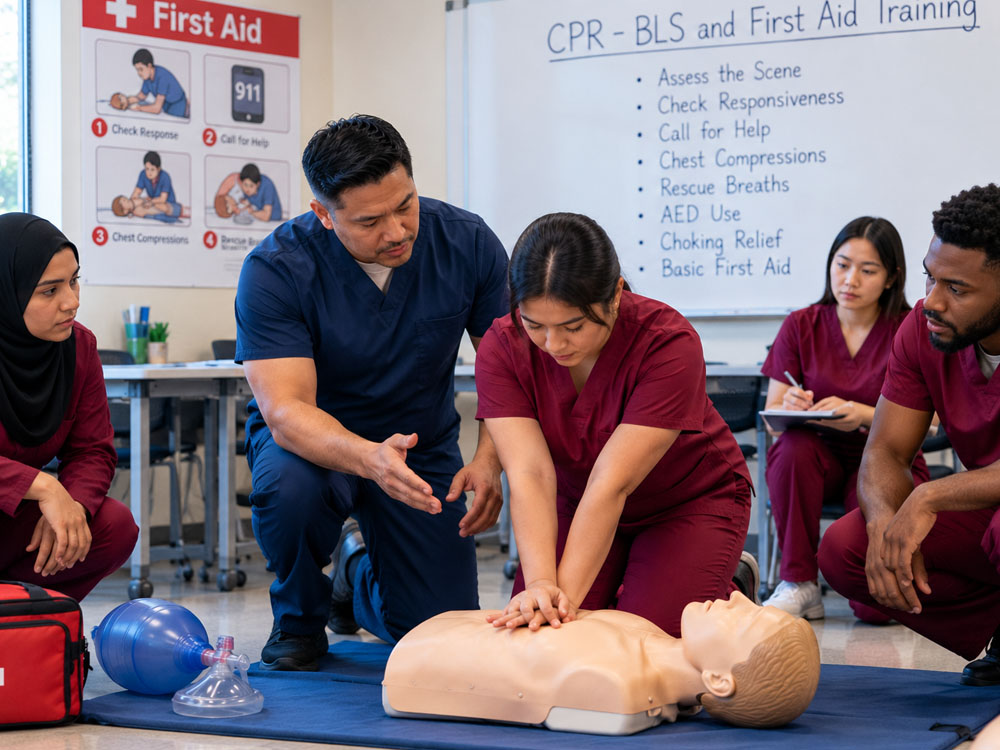
During practical CPR and BLS instruction, students can learn how proper hand placement, compression depth, and compression rate affect the quality of CPR. Training manikins allow participants to practice techniques in a controlled learning environment.
For BLS students, practice may also involve rescue breathing, AED operation, and responding as part of a healthcare team.
These exercises help students become more familiar with the physical steps involved in emergency care. Instructors can demonstrate techniques, correct mistakes, and evaluate skills according to the requirements of the course.
Some training formats combine online instruction with an in-person skills session. Others are completed through instructor-led classes. The available format depends on the specific course and training provider.
People enroll in CPR, BLS, and First Aid classes for different reasons.
A nursing student may need BLS training before beginning clinical rotations. A childcare employee may need CPR and First Aid training that meets workplace requirements. A parent might simply want to feel more prepared if an emergency happens at home.
For healthcare workers, keeping required training current is often part of maintaining employment or clinical eligibility. For people outside healthcare, the motivation may be personal rather than professional.
Either way, choosing the correct course matters. BLS training is not automatically interchangeable with every workplace CPR or First Aid requirement, and some employers specify which certification they accept.
Before registering, students should check whether their school, employer, or licensing organization requires a particular course, training provider, or completion card.
Our school is located at 17400 Vanowen Street in Lake Balboa, California, making it accessible to students and working professionals from Van Nuys, Reseda, Northridge, Encino, Sherman Oaks, and other San Fernando Valley communities.
Whether you’re preparing for a healthcare program, meeting an employment requirement, or interested in learning emergency response skills, understanding your training options is an important first step.
Our class schedules, course offerings, and enrollment availability may change from year to year. For the most current information about CPR, BLS, and First Aid classes, available training formats, and completion credentials, please contact Valley School of Nursing at (818) 206-5254.