We’re here to answer your questions, provide guidance, and help you take the next step with confidence.
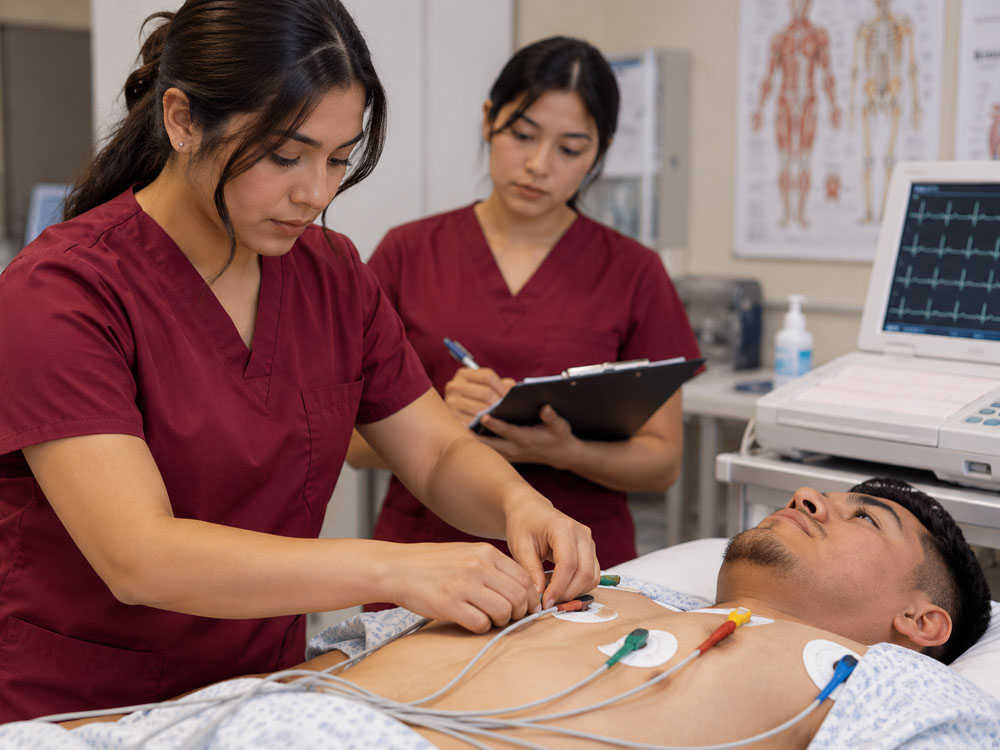
EKG Monitor Technicians play an important role in healthcare by observing patients’ heart rhythms and identifying changes that may require medical attention. Using cardiac monitoring equipment, these professionals help nurses and other healthcare providers monitor heart activity and respond to potential concerns.
EKG Monitor Technician training focuses on understanding the heart’s electrical system, recognizing cardiac rhythms, interpreting EKG tracings, and communicating findings accurately. Valley School of Nursing serves students throughout the San Fernando Valley and Los Angeles County who are interested in pursuing opportunities in cardiac monitoring and patient care.
An EKG Monitor Technician, also known as a Cardiac Monitor Technician or Telemetry Technician, observes patients’ heart rhythms through electronic monitoring systems. These systems are commonly used in hospitals to monitor patients who require continuous cardiac observation.
Typical responsibilities include:
Monitor technicians do not independently diagnose cardiac conditions or make treatment decisions. Their observations support the clinical team in providing timely patient care.
The heart relies on electrical impulses to maintain a coordinated heartbeat. These signals travel through specialized pathways that control the contraction of the heart’s chambers.
Understanding the heart’s anatomy and electrical conduction system provides the foundation for interpreting EKG recordings. Important concepts include the sinoatrial (SA) node, atrioventricular (AV) node, and the pathways that carry electrical impulses through the heart.
Students studying cardiac monitoring learn how these electrical signals appear on an EKG tracing and how changes in conduction can affect the heart’s rhythm.
Reading EKG rhythm strips is a fundamental skill for cardiac monitoring professionals. A rhythm strip displays the heart’s electrical activity and helps trained personnel evaluate heart rate, rhythm regularity, and electrical conduction.
Key elements of an EKG tracing include:
Rhythm interpretation also involves calculating heart rate, identifying irregular patterns, and recognizing changes that should be reported to the healthcare team.
Cardiac arrhythmias occur when the heart’s electrical activity produces an abnormal rhythm or rate. Recognizing these patterns is an important part of cardiac monitoring.
Common rhythms studied in cardiac monitoring education may include:
Recognizing these rhythms helps monitor technicians identify changes and promptly communicate potentially serious findings to authorized clinical personnel. The exact rhythms covered in a training program depend on its curriculum.
Telemetry systems allow healthcare professionals to observe patients’ cardiac rhythms continuously. Unlike a standard EKG test, which records heart activity during a brief examination, telemetry provides ongoing rhythm information.
Monitor technicians may observe several patients from a centralized monitoring station. They watch for rhythm changes, review monitor alarms, and report significant findings to the nursing team.
They must also recognize technical problems, including loose electrodes, patient movement, and electrical interference that can affect the accuracy of a tracing.
Although the titles are sometimes used interchangeably, the two positions often involve different responsibilities.
EKG Technicians primarily perform electrocardiogram tests by preparing patients, placing electrodes, operating EKG machines, and recording the heart’s electrical activity.
EKG Monitor Technicians focus on observing cardiac rhythms over time, recognizing changes, reviewing telemetry displays, and reporting findings to healthcare professionals.
Some healthcare employers combine these responsibilities, so job requirements may vary.
EKG Monitor Technician education combines knowledge of cardiac anatomy and electrical activity with practical rhythm recognition and professional communication.
Areas commonly associated with this type of training include:
Prospective students should confirm the specific curriculum, practical exercises, admission requirements, and course completion standards directly with Valley School of Nursing.
EKG Monitor Technicians may find employment opportunities in hospitals and other healthcare facilities that provide continuous cardiac monitoring.
Potential work environments include:
Employment requirements vary by facility. Some employers may require additional certifications, demonstrated competencies, or previous healthcare experience. Completing a training program does not guarantee employment or professional certification.