We’re here to answer your questions, provide guidance, and help you take the next step with confidence.
When someone spends weeks recovering from surgery, illness, or an injury, getting back to everyday activities isn’t always easy. Even after rehabilitation, walking across a room, getting dressed, or standing up from a chair can remain challenging. Without regular movement and encouragement, some people may gradually lose abilities they worked hard to regain.
That’s where restorative nursing comes in.
Restorative Nursing Assistants (RNAs) help patients continue practicing everyday activities, maintain physical abilities, and participate as independently as possible in their own care. It’s a specialized approach that builds on the responsibilities of a Certified Nursing Assistant (CNA).
Valley School of Nursing offers Restorative Nursing Assistant training in Lake Balboa for individuals interested in expanding their knowledge of restorative patient care. The school serves students throughout the San Fernando Valley and surrounding Los Angeles County communities.
Rehabilitation doesn’t always end when a patient leaves a therapy session. For many people in skilled nursing and long-term care facilities, maintaining progress requires continued practice throughout the week.
Consider someone recovering from a stroke who has difficulty using one side of their body. A rehabilitation professional may establish specific activities to support movement and everyday functioning. Between therapy sessions, nursing staff may help the patient continue appropriate activities as part of an established restorative care plan.
The same principle applies to someone living with arthritis, recovering from a fracture, or experiencing gradual changes in mobility.
Restorative nursing focuses on making these activities part of daily care. The objective may be to improve a person’s ability to move, maintain a skill they already have, or prevent unnecessary loss of function.
Imagine a nursing assistant helping a resident get dressed in the morning. The resident moves slowly and has difficulty fastening buttons. It might be faster for the assistant to complete the entire task.
But what if the resident can still manage part of it independently?
A restorative approach encourages the person to participate in the activities they’re capable of performing safely. That might mean allowing extra time, offering verbal guidance, or providing an adaptive device recommended in the care plan.
It’s a small difference in how care is delivered, but an important one.
Doing everything for someone can sometimes reduce opportunities to use existing abilities. Restorative nursing emphasizes appropriate assistance while encouraging participation, confidence, and independence.
Of course, safety always comes first. Restorative Nursing Assistants follow established care plans and supervision requirements rather than asking patients to attempt activities beyond their abilities.
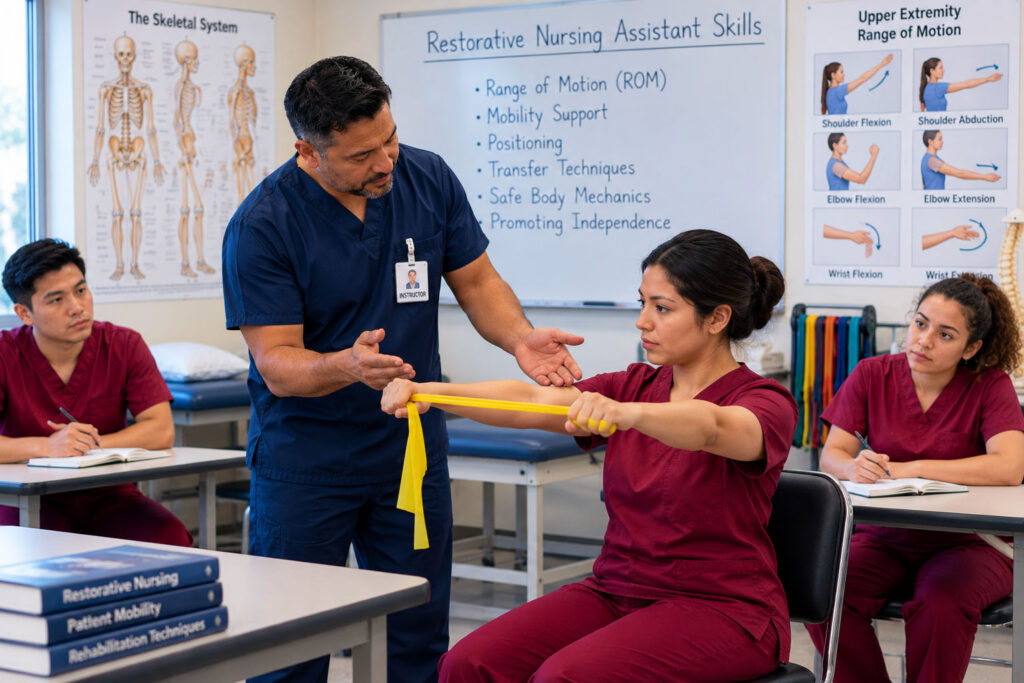
Restorative Nursing Assistant classes introduce techniques commonly used to help patients maintain movement and everyday functioning.
Students learn about activities such as range-of-motion exercises, which involve moving joints through appropriate movements to help maintain flexibility. They also become familiar with safe walking assistance, transfers between beds and chairs, positioning, and the use of mobility aids.
Restorative care can extend beyond walking and exercise. Depending on the patient’s needs and care plan, it may involve assistance with eating, dressing, grooming, and other activities of daily living.
Training commonly addresses several areas:
The purpose isn’t simply to memorize procedures. It’s to understand how these activities fit into a patient’s ongoing care and why consistent, appropriate assistance matters.
In a skilled nursing facility, restorative responsibilities may be organized around scheduled activities for individual residents.
An RNA might begin by reviewing assigned restorative care plans with the nursing team. One resident may need assistance practicing walking with an approved mobility aid. Another may have a range-of-motion program, while someone else may be working on participating more independently during meals.
Throughout these activities, the RNA pays attention to how each person responds. Is the resident unusually tired? Are they experiencing discomfort? Have they become less willing or able to participate?
These observations are important because changes may need to be reported to the supervising nurse.
Restorative Nursing Assistants do not independently prescribe exercise programs or provide physical or occupational therapy. They carry out assigned activities within their responsibilities, under appropriate supervision, and in coordination with the patient’s healthcare team.
Certified Nursing Assistants already have experience helping patients with mobility, personal care, and daily routines. Restorative Nursing Assistant training introduces a more specialized understanding of how these responsibilities can support a person’s ability to function over time.
For CNAs working in long-term care or skilled nursing facilities, this additional training can be useful when assisting residents who need ongoing mobility support or participate in restorative nursing programs.
Some facilities have designated RNA positions, while others assign restorative responsibilities to nursing assistants as part of their regular work.
RNA training does not replace CNA certification or create a separate California Department of Public Health-issued RNA license. It provides additional education in restorative care practices that may be relevant to certain nursing assistant assignments.
Restorative Nursing Assistant courses are generally intended for individuals who already have a foundation in nursing assistant care. Many California training providers require current CNA certification before enrollment.
RNA courses are often relatively short compared with initial CNA training. Some California schools offer 16-hour programs, while others provide longer courses with additional instruction or practice. The exact duration and requirements depend on the training provider.
Students considering Valley School of Nursing’s Restorative Nursing Assistant program should confirm the current course length, CNA prerequisites, and class schedule with the school.
For nursing assistants interested in understanding restorative care more deeply, the program introduces a different way of approaching familiar responsibilities: not only helping patients complete daily activities, but also recognizing opportunities to preserve the abilities that make those activities possible.